
Western wear market to reach $2,410 billion by 2035, with CAGR of 4.5%
Driven by casualisation and digital growth, the global western wear market will expand at a compound annual growth rate (CAGR) of 4.5 per cent from 2026.
LW Desk
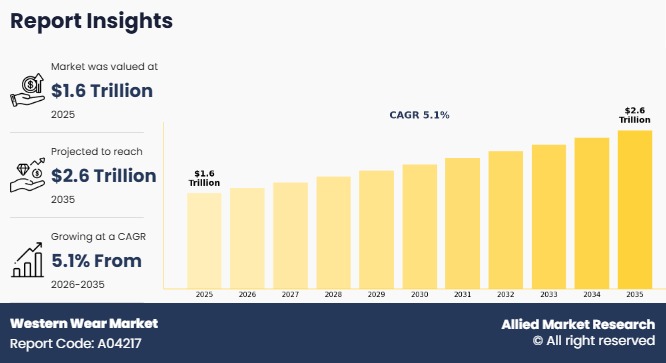
The global western wear market is projected to reach a valuation of $2,410.0 billion by 2035, expanding at a compound annual growth rate (CAGR) of 4.5 per cent from 2026, according to a study published by Allied Market Research.
The industry, which was valued at $1,550.0 billion in 2025, is experiencing widespread adoption across men, women, and kids demographics. This momentum is sustained by an extensive global ecosystem comprising apparel and footwear manufacturers, textile suppliers, digital commerce platforms, and omnichannel retail networks.
Demand is increasingly propelled by fast-fashion business models, changing workplace dress codes, structural shifts towards e-commerce, and a rising preference for comfort-driven, trend-led items. On a macro-level, broader socio-economic catalysts—such as escalating urbanization, rising disposable incomes, growing female workforce participation, and expanding fashion adoption among Gen Z and millennial cohorts—are further accelerating consumption across both developed and emerging economies.
Consumer Shifts and Sector Dynamics
The market is characterized by a structural division between casual and formal attire. The casual wear segment currently commands the largest share of the market, underpinned by the widespread adoption of comfort-oriented fashion, hybrid work cultures, and relaxed workplace dressing norms. This shift has driven robust consumer demand for denim wear, oversized apparel, athleisure-inspired clothing, and casual footwear.
Conversely, formal wear maintains a stable and loyal consumer base. Corporate leaders and business entities continue to adhere to traditional business attire, ensuring consistent demand for professional garments, premium lifestyle products, and occasion-based dressing. Over the forecast period, however, the casual wear segment is expected to gain relatively higher traction.
By product type, the apparel segment accounted for the largest share of market revenue in 2025, buoyed by high consumption frequencies and a broad product variety spanning T-shirts, blouses, jeans, trousers, skirts, and jackets. Meanwhile, the footwear segment—encompassing sneakers, boots, and formal shoes—is anticipated to register faster growth over the forecast period, driven by an accelerating global sneaker culture and a heightened consumer preference for functional, premium casual shoes.
Demographic and Channel Insights
Based on end-user segmentation, the women segment holds the largest market share. This position is sustained by a higher frequency of fashion purchases, greater product availability, and strong expenditure across casual, formal, and occasion-specific categories. The men segment remains a significant contributor due to escalating demand for premium apparel and lifestyle footwear, while the kids segment exhibits steady growth, supported by rising parental expenditure on branded products.
Distribution channels are simultaneously undergoing a clear evolution. Specialty stores and brand outlets collectively command a significant market share, remaining vital due to their high brand visibility, curated assortments, and premium consumer experiences. Supermarkets and hypermarkets retain their relevance by catering primarily to value-oriented and mass-market categories.
Concurrently, online platforms have emerged among the fastest-growing distribution channels. This digital acceleration is heavily supported by rising electronic commerce penetration, social commerce adoption, direct-to-consumer retail models, and omnichannel integration.
Technological Transformation and Retail Innovation
Operational landscapes within the fashion industry are being fundamentally reshaped by rapid digital transformation. Companies are increasingly deploying artificial intelligence (AI) for demand forecasting, inventory optimization, dynamic pricing, and predictive fashion trend analysis. Data analytics and digital consumer intelligence have become crucial institutional tools, enabling brands to monitor purchasing patterns and engagement metrics in real time to secure a competitive edge.
Furthermore, retail technologies such as virtual fitting tools, interactive shopping mechanisms, and AI-enabled style recommendations are actively being used to enhance purchase confidence and mitigate product return rates. Operational scalability is further aided by the implementation of cloud-based retail technologies, automated fulfillment systems, and mobile commerce platforms.
Besides technology, sustainability has emerged as a key operational differentiator. Brands are directing investments towards eco-friendly materials, recycled fabrics, ethical sourcing, vegan leather alternatives, and circular fashion initiatives. These innovations, alongside automation-led supply chain optimizations, are viewed as essential mechanisms to mitigate prevailing industry challenges, which include intense fast-fashion competition, pricing pressures, raw material cost volatility, demand forecasting complexities, and supply chain disruptions.
Regional Variations
The global western wear market is projected to reach a valuation of $2,410.0 billion by 2035, expanding at a compound annual growth rate (CAGR) of 4.5 per cent from 2026, according to a study published by Allied Market Research.
The industry, which was valued at $1,550.0 billion in 2025, is experiencing widespread adoption across men, women, and kids demographics. This momentum is sustained by an extensive global ecosystem comprising apparel and footwear manufacturers, textile suppliers, digital commerce platforms, and omnichannel retail networks.
Demand is increasingly propelled by fast-fashion business models, changing workplace dress codes, structural shifts towards e-commerce, and a rising preference for comfort-driven, trend-led items. On a macro-level, broader socio-economic catalysts—such as escalating urbanization, rising disposable incomes, growing female workforce participation, and expanding fashion adoption among Gen Z and millennial cohorts—are further accelerating consumption across both developed and emerging economies.
Consumer Shifts and Sector Dynamics
The market is characterized by a structural division between casual and formal attire. The casual wear segment currently commands the largest share of the market, underpinned by the widespread adoption of comfort-oriented fashion, hybrid work cultures, and relaxed workplace dressing norms. This shift has driven robust consumer demand for denim wear, oversized apparel, athleisure-inspired clothing, and casual footwear.
Conversely, formal wear maintains a stable and loyal consumer base. Corporate leaders and business entities continue to adhere to traditional business attire, ensuring consistent demand for professional garments, premium lifestyle products, and occasion-based dressing. Over the forecast period, however, the casual wear segment is expected to gain relatively higher traction.
By product type, the apparel segment accounted for the largest share of market revenue in 2025, buoyed by high consumption frequencies and a broad product variety spanning T-shirts, blouses, jeans, trousers, skirts, and jackets. Meanwhile, the footwear segment—encompassing sneakers, boots, and formal shoes—is anticipated to register faster growth over the forecast period, driven by an accelerating global sneaker culture and a heightened consumer preference for functional, premium casual shoes.
Demographic and Channel Insights
Based on end-user segmentation, the women segment holds the largest market share. This position is sustained by a higher frequency of fashion purchases, greater product availability, and strong expenditure across casual, formal, and occasion-specific categories. The men segment remains a significant contributor due to escalating demand for premium apparel and lifestyle footwear, while the kids segment exhibits steady growth, supported by rising parental expenditure on branded products.
Distribution channels are simultaneously undergoing a clear evolution. Specialty stores and brand outlets collectively command a significant market share, remaining vital due to their high brand visibility, curated assortments, and premium consumer experiences. Supermarkets and hypermarkets retain their relevance by catering primarily to value-oriented and mass-market categories.
Concurrently, online platforms have emerged among the fastest-growing distribution channels. This digital acceleration is heavily supported by rising electronic commerce penetration, social commerce adoption, direct-to-consumer retail models, and omnichannel integration.
Technological Transformation and Retail Innovation
Operational landscapes within the fashion industry are being fundamentally reshaped by rapid digital transformation. Companies are increasingly deploying artificial intelligence (AI) for demand forecasting, inventory optimization, dynamic pricing, and predictive fashion trend analysis. Data analytics and digital consumer intelligence have become crucial institutional tools, enabling brands to monitor purchasing patterns and engagement metrics in real time to secure a competitive edge.
Furthermore, retail technologies such as virtual fitting tools, interactive shopping mechanisms, and AI-enabled style recommendations are actively being used to enhance purchase confidence and mitigate product return rates. Operational scalability is further aided by the implementation of cloud-based retail technologies, automated fulfillment systems, and mobile commerce platforms.
Alongside technology, sustainability has emerged as a key operational differentiator. Brands are directing investments towards eco-friendly materials, recycled fabrics, ethical sourcing, vegan leather alternatives, and circular fashion initiatives. These innovations, alongside automation-led supply chain optimizations, are viewed as essential mechanisms to mitigate prevailing industry challenges, which include intense fast-fashion competition, pricing pressures, raw material cost volatility, demand forecasting complexities, and supply chain disruptions.
Regional Variations
Geographically, the global market displays highly distinct consumption patterns and retail structures across its analytical territories.
North America represented one of the largest and most developed regional markets in 2025. Growth in this territory is sustained by high per-capita spending on apparel and footwear, a mature organized retail ecosystem, advanced e-commerce infrastructure, and a deeply entrenched sneaker culture.
Europe remains an exceptionally trend-driven and high-value market, supported by established fast-fashion networks. The region is increasingly characterized by stringent sustainability regulations, ethical sourcing mandates, and an escalating consumer preference for environmentally responsible fashion choices.
The Asia-Pacific region is projected to register the fastest growth rate over the forecast period. Driven by rapid urbanization, expanding middle-class populations, and rising female workforce participation, countries such as China, India, Japan, South Korea, and Australia are experiencing robust demand. The region is quickly establishing itself as a major digital retail hub due to extensive mobile commerce adoption.
The LAMEA region is witnessing gradual but consistent growth. Within this territory, the Middle East benefits from sustained luxury fashion demand, premium retail developments, and growing adoption among younger demographics and working women. Latin America is supported by an expanding presence of international brands, while Africa represents a viable long-term opportunity as urban retail infrastructure continues to improve.
Despite localized challenges—including a persistent consumer preference for traditional ethnic wear in certain regions—the global market is expected to maintain steady growth, driven by regional customization, supply chain agility, and premium product development.