
Regulatory failures and weak infra cost South Asian leather billions
LW Desk
The leather sector, along with the garment industry, is a critical pillar of the economy in Bangladesh. As a highly labour-intensive manufacturing sector, it plays an indispensable role in national development and holds immense potential for future growth. The country is home to vast raw leather resources, yet it has consistently failed to tap this potential for its broader socio-economic growth.
One of the greatest challenges facing the sector is systemic compliance failure, a deficiency that experts and industry leaders agree causes the country to lose billions of dollars in the raw leather trade. Decades of infrastructure neglect have only compounded these woes, locking the nation into low-value exports and shutting it out of premium global markets. Shortcomings at the Savar Tannery Industrial Estate serve as a primary example of this stagnation.
Across the border, India’s leather industry too finds itself in a remarkably similar predicament, shedding billions due to supply chain mismanagement, compliance bottlenecks, religious sensitivities, and ongoing controversies surrounding animal sacrifice.
Squandering of Vast Potential
Bangladesh accounts for approximately 4% of the world’s rawhide and skin resources, producing an estimated 350 to 400 million square feet of hides and skins annually. According to Md Mizanur Rahman, professor and director of the Institute of Leather Engineering and Technology at the University of Dhaka, the country could generate up to $10 billion to $12 billion in export earnings from its existing raw materials alone if the sector were fully utilized.
Instead, Bangladesh is sitting on a massive resource that it cannot properly manage. Professor Rahman estimates that nearly 30% of the country’s leather is entirely wasted due to poor preservation, inadequate processing capacity, and a failure to utilize tannery by-products. This waste is particularly stark given that the leather sector offers one of the highest value-addition opportunities in the domestic manufacturing industry, with up to 90% value addition possible since the vast majority of raw materials are sourced locally.
Tanners Fall Prey to Foreign Price Exploitation
This structural mismanagement leaves local traders exposed to severe price exploitation by foreign buyers, particularly Chinese firms. These buyers frequently purchase Bangladeshi leather for as little as 40 to 50 cents per square foot, only to process it and resell it on international markets for around $2 per square foot.
Consequently, much of the profit generated from Bangladesh's natural wealth ends up overseas, leaving local producers with negligible returns. A substantial portion of this lost potential lies in unused by-products. Professor Rahman notes that tannery waste can be processed into collagen, gelatin, fertilizer, and animal feed. If these secondary industries were formalized, they would generate new demand for hides and push up their market value, fulfilling the economic principle that every single part of the leather resource holds financial worth.
Myriad Issues at Play at Savar
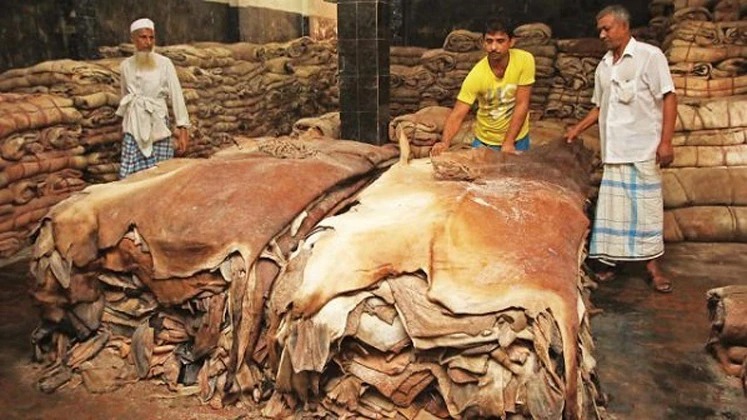
The inherent seasonality of the trade adds another layer of operational difficulty for Bangladesh. Approximately 40% to 45% of the country’s annual rawhide enters the market within a tight three-day window during Eid-ul-Azha. This sudden influx places enormous strain on domestic processing capacity, making efficient handling absolutely critical to securing better prices.
However, a severe lack of internationally compliant environmental infrastructure at the Savar Tannery Industrial Estate limits the sector’s ability to move up the value chain. Md Tipu Sultan, chairman of the Bangladesh Finished Leather, Leather Goods and Footwear Exporters Association, underlines that the country continues to receive depressed prices globally because local factories have yet to meet recognized compliance standards.
Compliance Gaps Stifle Growth
This compliance gap remains the central obstacle to growth. Currently, only a handful of factories hold the internationally recognized certifications required by premium buyers in the United States and European markets. Chairman Sultan states that one or two compliant factories are simply not enough to shift global perceptions. If at least 50 out of the roughly 150 operating factories could achieve these rigorous standards, compliance-focused international buyers would return to source products from Bangladesh. Swift movement on these issues could resolve many of the recurring structural problems facing the leather sector before the next Eid-ul-Azha season.
Broken Infrastructure Commitment
At the factory level, frustration runs even deeper due to historical policy execution. Md Salauddin Ahmed, managing director of New Kajol Tannery Ltd and treasurer of the exporters association, traces the current predicament back to the forced relocation of tanneries from Hazaribagh to Savar. The government initially promised full infrastructure support, but many factories were compelled to move before essential facilities were ready. Years after the relocation, several tanneries still face acute shortages of gas and other basic utilities, while the Central Effluent Treatment Plant fails to operate at its expected standard. These shortcomings prevent local tanneries from obtaining Leather Working Group certification, a non-negotiable requirement for supplying major global brands. As a result, European buyers bypass Bangladesh entirely, leaving the country heavily dependent on Chinese buyers who dictate prices. This dependence is reflected in razor-thin margins, with processed leather selling at just 50 to 55 cents per square foot, which barely covers production costs. Because tanners must import most of their chemicals, a strengthening US dollar has driven up operational expenses sharply, ensuring that even cheap domestic raw hides offer little financial relief.
Socio-Economic Cost
Beyond balance sheets and trade deficits, the failure to achieve global compliance inflicts a severe socio-economic drain on Bangladesh. It suppresses rural wages, impacts human capital, and accelerates environmental degradation. Historically engineered to drive mass employment and rapid poverty alleviation, the industry remains economically paralysed. By remaining locked out of affluent Western markets, the sector leaves millions of smallholder farmers, rural livestock herders, and informal traders trapped at the bottom of the supply chain, forced to sell their goods at subsistence rates while foreign middlemen pocket the profits. Furthermore, the delay in establishing compliant waste management infrastructure inflicts heavy ecological and public health costs on manufacturing communities. Instead of creating a booming circular bio-economy, Bangladesh effectively exports its valuable wealth overseas while retaining 100% of the industrial waste and structural poverty at home.
India’s Structural Wastage & Supply Chain Decay
Across the border, in India, a parallel crisis unfolds within the upstream segments of the leather industry. While there is no single, consolidated official real-time figure from the government quantifying the exact metric tonnage of raw hides wasted strictly due to post-slaughter handling errors, comprehensive industrial studies paint a clear structural picture. Notably, the 2025 Parliamentary Standing Committee report on the Indian Leather Industry had highlighted massive value depreciation manifesting through raw material degradation, physical solid waste generation, and underutilized by-products.
Degradation of Hides in Transit
The primary point of waste occurs even before hides reach the tanneries. Because the Indian livestock and carcass collection sector is highly unorganized and fragmented, a significant percentage of fallen or slaughtered animal hides suffer from severe quality degradation. Due to a total lack of cold-chain infrastructure or immediate chemical curing at the source, bacterial putrefaction begins rapidly.
Delays in transportation and long chains of intermediaries mean that a substantial volume of raw hides arrive at tanneries as lower-grade material or completely unusable, rotten hides. This is further aggravated by poor manual flaying techniques, where inappropriate skinning tools cause deep cuts and scores that ruin the prime grain layer of the hide. Coupled with branding marks and parasite scars, Indian tanneries are routinely forced to process lower-grade corrected grain leather rather than premium, higher-margin full-grain leather.
India’s Inept Processing & Regulatory Bottlenecks
In terms of pure volumetric waste, the leather processing stage in India is incredibly inefficient. On average, only about 15% of the total raw hide weight actually makes it into the final usable finished leather, while the remaining 85% is discarded as solid and liquid waste during beamhouse, tanning, and post-tanning operations. Processing one ton of wet-salted raw hides typically generates 50% to 60% fleshing waste consisting of fat and subcutaneous tissue, 35% to 40% hazardous chromium-laden shavings and dust, and 5% to 7% skin trimmings.
Smaller Units’ Capital Constraints
India’s tanning sector is heavily dominated by MSMEs and micro-units clustered in regions like Tamil Nadu, Uttar Pradesh, and West Bengal. While large corporate tanneries deploy modern, low-waste technologies, smaller units lack the capital to upgrade to automated, green machinery, resulting in inefficient chemical penetration and higher rejection rates. Furthermore, processing capacity is strictly bound by the capacity of Common Effluent Treatment Plants. Tanneries frequently operate under capacity restrictions or face abrupt closure orders from State Pollution Control Boards due to pollution violations, leaving raw hides stored in subpar conditions where they quickly rot.
This wastage is compounded because valuable tannery by-products are treated as environmental liabilities rather than economic resources. Non-chrome wastes like raw trimmings could easily be channeled into industrial gelatin, animal feed, or organic fertilizers, but a lack of organized collection links means this protein-rich waste is simply openly dumped. Similarly, specialized chemical extraction plants for hazardous chrome wastes are sparse, leaving spent chrome shavings to accumulate and degrade the land.
Environmental Pressures
Tanning in India has become a primary target for environmental regulators and judicial interventions, highlighted by landmark Supreme Court rulings on river basin pollution in clusters like Kanpur and Vellore. Tanneries are legally required to adhere to strict Zero Liquid Discharge norms, which increases production costs by 10% to 15% and heavily squeezes the margins of small tanners. Additionally, while 85% to 90% of tanning relies on Chromium (III) salts, international markets are tightening regulations around carcinogenic Chromium (VI), which forms due to improper processing. Transitioning to eco-friendly, chrome-free or vegetable tanning requires expensive chemicals and longer cycles that smaller units cannot afford. These challenges are exacerbated by labour deficits, as youth migrate toward cleaner manufacturing sectors, and rising competition from high-performance synthetic substitutes like polyurethane and silicone-based leather.
Policies Prevent Raw Leather Exports
On the macroeconomic front, India’s export basket reflects a deliberate policy framework designed to discourage the export of unprocessed raw materials. The Government of India imposes heavy export duties of up to 60% on raw hides, skins, and semi-processed leathers like wet blue. This fiscal wall ensures that tanneries do not ship raw wealth abroad, keeping materials available domestically for maximum value addition. Consequently, the direct export share of completely unprocessed raw hides and skins is virtually zero.
Indian Leather Export Performance in FY 2025-26
According to official trade data compiled by the Directorate General of Commercial Intelligence and Statistics and the Council for Leather Exports, India’s total leather and footwear exports reached $4.75 billion in the 2025-26 fiscal year, down slightly from $4.83 billion in the 2024-25 fiscal year.
The direct share of tannery output, categorized as finished leather, stood at $399.08 million in fiscal year 2025-26, down from $446.68 million the previous year, accounting for roughly 8.4% of the total export revenue. The rest of the export basket for fiscal year 2025-26 was dominated by leather footwear at $1.95 billion (41.05%), leather goods and accessories at $1.25 billion (26.31%), and leather garments at $416.29 million (8.76%), with the remaining 15.48% composed of other components, saddlery, and non-leather items. While the direct export share of finished leather has steadily shrunk over the last decade from over 20% down to the current 8.4%, economists and policymakers view this as a positive structural shift.
Instead of exporting finished leather sheets to competing manufacturing hubs like Italy, Vietnam, or China, Indian tanneries are increasingly selling their crusts and finished sheets domestically to home-grown footwear and apparel manufacturers. Thus, while the direct export share of the tanning segment is modest, its indirect contribution is nearly 100% for all genuine leather products exported, serving as the backbone of a major national export engine.
In conclusion, the structural paralysis gripping the leather sectors of Bangladesh and India reveals a profound paradox: both nations are drowning in raw material wealth while starved of its ultimate financial reward. For Bangladesh, the crisis is an agonizing failure of execution, where toxic infrastructure and compliance deficits turn a potential $12 billion windfall into a cut-rate monopoly for foreign middlemen.
For India, a fragmented supply chain and regulatory chokeholds cannibalize raw hides before they even see a tanning drum. Yet, while New Delhi has successfully deployed aggressive fiscal barriers to trap raw materials domestically and feed a booming, multibillion-dollar downstream manufacturing engine, Dhaka remains tragically caught in a cycle of environmental degradation and exported margins.
For both South Asian giants, the road forward demands an aggressive, uncompromising transition toward global environmental compliance and circular resource management. Until these state-of-the-art industrial standards are met, both nations will continue to bear the crushing ecological and social burdens of a primitive supply chain, effectively burying billions in untapped economic prosperity beneath their own soil.
India’s Leather Export Metrics
Total Exports (FY26): $4.75 billion, down from $4.83 billion in FY25.
Finished Leather: $399.08 million (8.4% of total), down from $446.68 million in FY25.
Leather Footwear: $1.95 billion (41.05%), dominating the basket.
Goods & Accessories: $1.25 billion (26.31%).
Leather Garments: $416.29 million (8.76%).
Other/Saddlery/Non-Leather: 15.48% of the total basket.
Decadal Trend: Finished leather’s export share shrank from 20% to 8.4%.
—