
Bangladesh targets $5bn leather, footwear exports by 2030
LW Desk
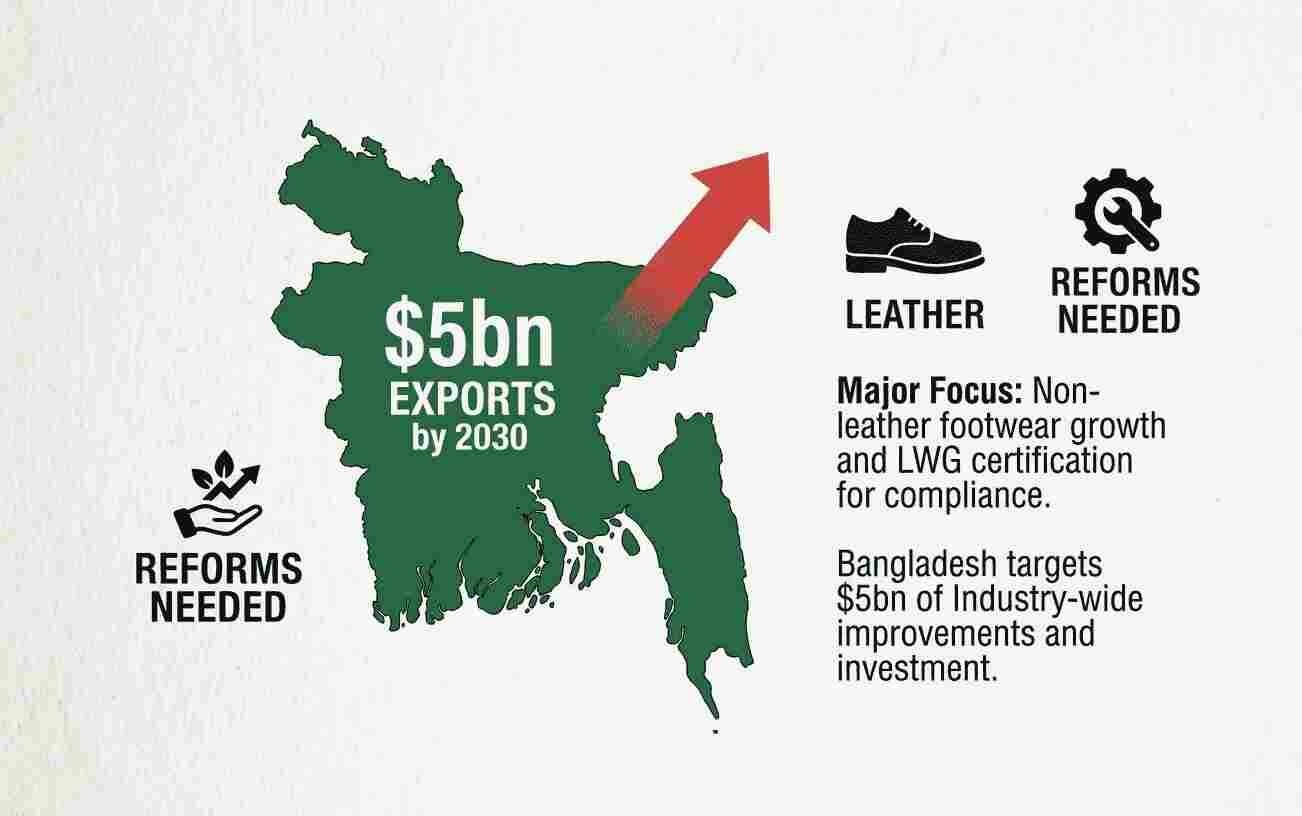
Bangladesh has set its sights on raising exports of leather, footwear and leather goods to US$5 billion by 2030, but achieving the target will require major policy reforms, improved industrial infrastructure, stronger environmental compliance and a shift towards higher value products, industry leaders said.
Syed Nasim Manzur, president of the Footwear, Leather goods & Accessories Exporters Association (FLAXA), outlined the target at a policy dialogue on advancing Bangladesh’s leather sector, organized by the South Asian Network on Economic Modeling (SANEM) and partners in Dhaka.
Bangladesh currently exports around $1.76 billion worth of footwear and leather goods to more than 105 countries, with the United States and India among its largest markets. Despite being the world’s seventh-largest footwear producer, the country has a relatively small share of global footwear trade.
Manzur said the sector should first target $3 billion in annual exports before moving towards the $5 billion goal. Easier access to bonded warehouse facilities could help exporters expand product lines, particularly in the non-leather segment.
Non-leather footwear is already a major growth area, accounting for nearly 31% of Bangladesh’s footwear and leather goods exports and growing faster than leather footwear. FLAXA estimates that Bangladesh currently has less than 0.5% of the global non-leather footwear market. Raising this share to 5% could generate around $3.5 billion in exports. A similar expansion in synthetic bags could potentially add another $3.4 billion.
Manzur called for separate customs rules and incentives based on specific Harmonised System (HS) codes for leather and non-leather products to eliminate confusion and inconsistent treatment.
The industry also needs to move away from exporting semi-finished leather. Around 65% of Bangladesh’s leather is exported as crust leather, limiting domestic value addition. Manzur urged greater investment in finished footwear, bags and leather goods, while suggesting that Bangladesh could import raw hides for processing as it imports cotton for its textile industry.
Infrastructure and environmental compliance remain key challenges. Manzur called for improvements in gas and power supplies, roads and other facilities at the Savar tannery estate and urged the government to make its Central Effluent Treatment Plant (CETP) fully operational.
Commerce Minister Khandakar Abdul Muktadir said the government is preparing an integrated reform plan for the sector. The government intends to make 100% compliance in tannery operations mandatory and plans to make Leather Working Group (LWG) certification compulsory to improve the international acceptance of Bangladeshi leather.
The Savar CETP, designed to handle 25,000 cubic meters of wastewater daily, currently has an effective capacity of around 14,000–15,000 cubic meters. The government is considering both renovation and construction of a new treatment facility.
The government also plans to improve market access in Japan, South Korea and Europe, attract investment from Spanish and Italian leather companies, and establish a skills and design development center in Savar by 2027.
Manzur said a comprehensive strategy and targeted roadmap could make the $5 billion export target achievable, provided Bangladesh strengthens competitiveness across the entire leather and footwear value chain.
Top Stories
Related Articles

Four-Day Asia Bags and Cases Fair, Scheduled From October 30, Grows 2.5 Times in Size
Jordan’s Leather and Garment Sector Targets $5.5 Billion in Annual Exports, Plans IFC-Backed Textile Cluster
Agra Footwear Industry Favours Global Tech Adoption for Elevating Production