
Jordan’s Leather and Garment Sector Targets $5.5 Billion in Annual Exports, Plans IFC-Backed Textile Cluster
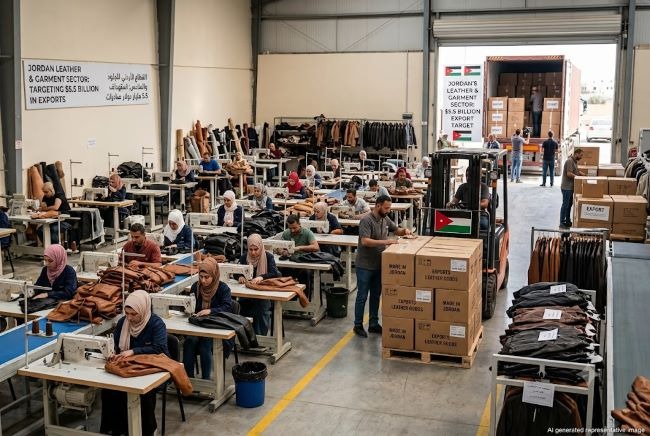
Jordan’s leather and garment industry is pursuing an integrated textile cluster, stronger supply chains and new export markets as the country targets $5.5 billion in annual exports.
LW Desk
Jordan’s leather and garment manufacturing sector is pursuing higher investment, stronger domestic supply chains, and expanded export opportunities under the country’s Economic Modernization Vision, according to the Jordan News Agency (Petra).
Petra reported that Ehab Qadri, sector representative at the Jordan Chamber of Industry (JCI), said technical assessments and site-selection studies are underway with the International Finance Corporation (IFC) for a proposed integrated textile industrial cluster. The project aims to strengthen production links, increase local raw material sourcing, and attract foreign investment in yarns, fabrics, and garment accessories.
Exports Reach $1.5 Billion in Seven Months
The sector generated gross output exceeding JOD 3 billion ($4.23 billion) in 2025, equivalent to approximately 2 percent of Jordan’s gross domestic product (GDP). Value-added activities contributed JOD 850 million, Petra reported.
Exports increased by 3.2 percent during the first seven months of 2026 to reach $1.5 billion. Full year exports totalled $2.4 billion in 2025, covering 80 international markets.
The United States accounted for 77.3 percent of sector exports, while other destinations included Canada, the United Kingdom, Germany, the Netherlands, Belgium, and Mexico. International Trade Centre (ITC) estimates also identify approximately $918 million in untapped export potential for Jordanian textile products in non-traditional markets.
Employment and Infrastructure Expand
Jordan’s leather and garment industry comprises 818 industrial establishments with registered capital of JOD 138 million. It employs around 99,000 workers, representing 38% of the national industrial workforce.
Employment of Jordanian nationals has grown by more than 130% over the past decade, exceeding 31,000 workers. The sector operates 30 satellite production facilities across rural governorates, with three additional branches planned for 2026.
New specialized fabric manufacturing facilities and logistics hubs recently established in Mafraq and Aqaba are expected to improve supply chain efficiency and reduce delivery times.
Sustainability Gains Importance
Manufacturers are working to adapt to evolving international requirements covering EU Ecodesign standards, supply chain traceability, and Digital Product Passports (DPPs).
Meanwhile, the JCI is coordinating with the Ministry of Investment to develop a national roadmap for textile waste recycling and circular economy infrastructure, supporting resource efficiency and more sustainable production.
Long-Term Growth Targets
Jordan’s Economic Modernization Vision aims to attract $3.1 billion in cumulative investment, increase annual exports to $5.5 billion, raise annual value-added by 10%, and create 149,000 direct employment opportunities for Jordanian nationals over the coming decade.
The proposed industrial cluster, infrastructure development, and efforts to diversify export markets are expected to support the sector’s competitiveness and strengthen Jordan’s position in international manufacturing supply chains.
Source: Jordan News Agency (Petra).