
Brazil Records 216 Active Tanneries in 2026 Leather Sector Study
CICB survey reports 77.6 million square meters of finished leather production, highlighting industry restructuring and the dominance of small and medium-sized enterprises.
LW Desk
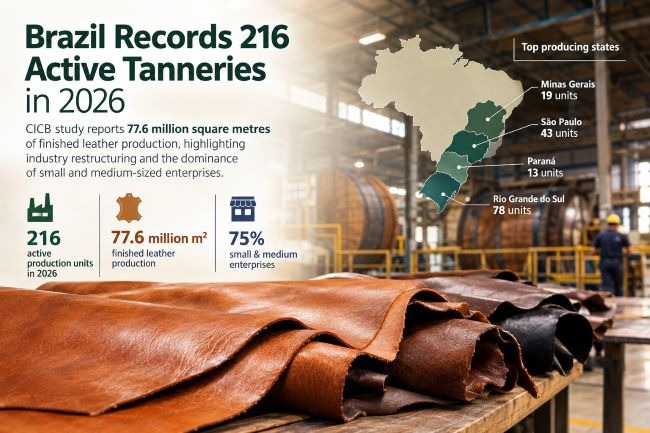
Brazil’s leather industry recorded 216 active production units in 2026, as the sector continued to restructure while maintaining a slight increase in finished leather output, according to a new study released by the Brazilian Leather Industry Center (CICB) on October 21.
The 2026 Leather Sector Study assesses the country’s tanning infrastructure, manufacturing profile and market dynamics. The biennial survey was conducted under a leather industry internationalization project jointly implemented by CICB and the Brazilian Trade and Investment Promotion Agency (ApexBrasil), with analytical support from the CEI Research Center at the University of Vale do Rio dos Sinos (Unisinos).
Despite the decline in the number of production units, Brazil’s finished leather output reached 77.6 million square meters, up from 77.3 million square meters recorded in the 2024 survey. The figures indicate that the industry has maintained production volumes even as its manufacturing base has gradually contracted.
The number of active units fell from 222 in 2022 to 221 in 2023 and 218 in 2024, before reaching 216 in 2026. This trend reflects continuing changes in the structure of Brazil’s tanning industry.
Southern and Southeastern States Lead Production
Brazil’s leather manufacturing activity remains concentrated in the South and Southeast, where established livestock supply chains and downstream industries support tanning operations.
Rio Grande do Sul leads the country with 78 production units, followed by São Paulo with 43. Minas Gerais ranks third with 19 units, while Paraná accounts for 13 tanneries.
Together, these four states represent 153 of Brazil’s 216 active production units, underlining their importance to the country’s leather manufacturing network.
SMEs Dominate the Industry Structure
Small and medium sized enterprises form the backbone of Brazil’s tanning sector. According to CICB, small companies account for 38.9% of active production units, while medium-sized businesses represent 36.1%.
Combined, these categories make up 75% of the country’s tanning establishments, highlighting the significant role of smaller manufacturers in the industry.
The findings provide an updated picture of Brazil’s leather sector as manufacturers adapt their operations and maintain production levels amid a changing industrial landscape. The study also offers industry stakeholders a statistical basis for understanding the country’s manufacturing capacity and regional production structure.